Key Takeaways
- Families form opinions about your community before they ever book a tour
- Pre-tour education directly impacts tour quality and conversion
- The goal is not more tours, but better prepared tours
Families Evaluate Your Community Long Before Touring a Senior Living Property
Most families complete extensive online research before contacting a prospective community. They are comparing care levels, pricing signals, and how each community feels from the outside looking in.
At this stage, they are not looking for a visit. They are trying to reduce risk.
They want to know whether your community can support older adults, whether there is a clear path for support, and whether the environment aligns with their expectations for emotional well-being.
If these questions are not answered early, hesitation builds. Many families delay booking simply because they do not feel ready to evaluate the right senior living community in person.
What Families Need Before Booking a Senior Living Tour Is Clarity, Not More Information
More information does not create progress. Clarity does.
Families need to understand how your community fits into the broader senior living landscape. This includes clear positioning between assisted living communities, assisted living and memory care, and memory care communities, as well as how these differ from a nursing home.
They also need transparency around medical services, medical support, and how you handle medical emergencies. This is not a secondary concern. For many families, it is the primary driver behind the decision.
When communities fail to address these topics before the tour, conversations remain surface-level. When they are addressed early, families arrive ready to discuss specifics such as care plans, medication management, and long-term needs.
Show Daily Life So Families Can Understand How Residents Actually Live
Families are not evaluating amenities. They are trying to understand daily life.
Generic descriptions of activities do very little to move the decision forward. What matters is whether families can picture how residents interact, how current residents spend their time, and how new residents are integrated into the community.
This is where resident engagement becomes a deciding factor.
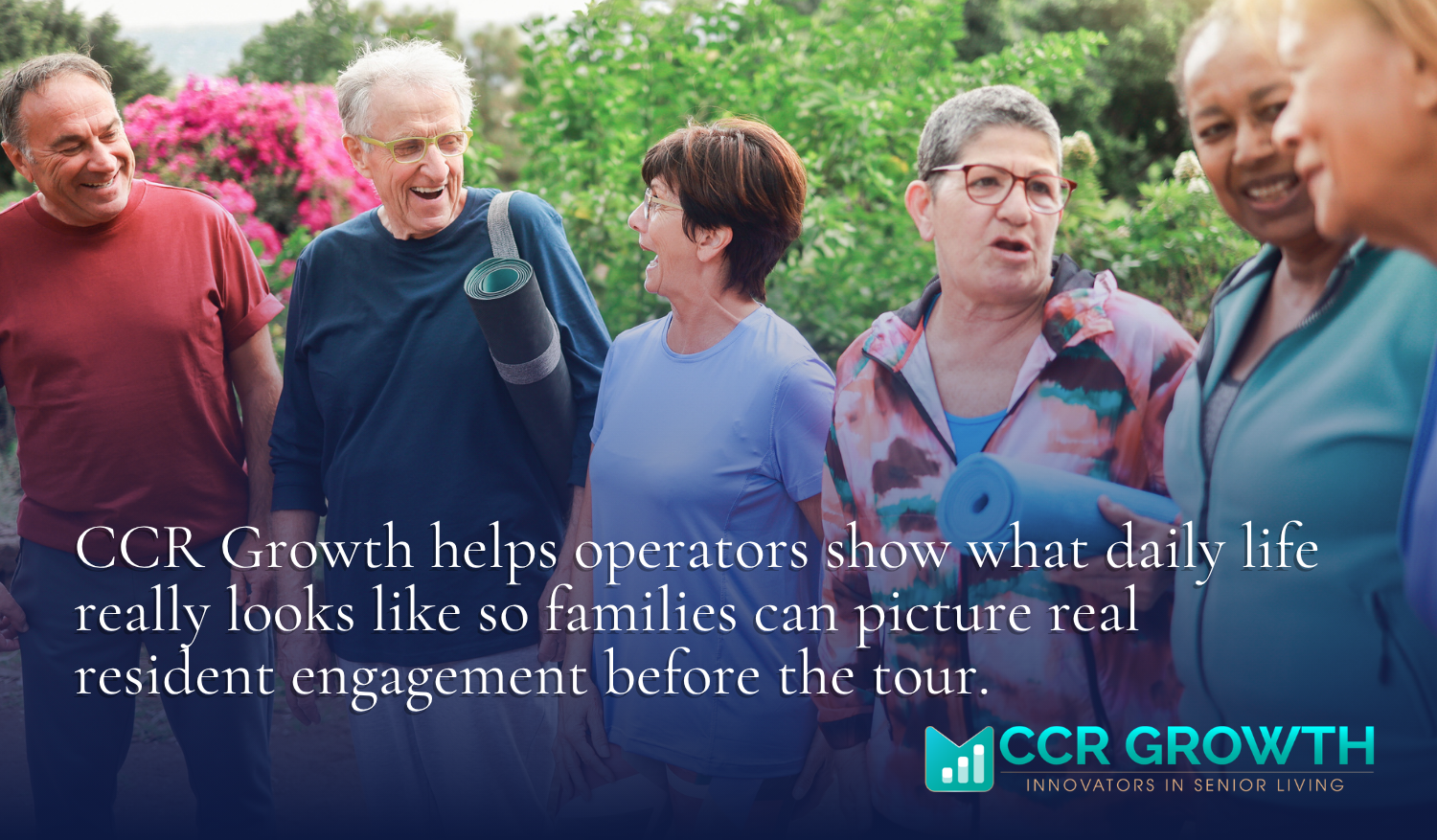
Communities should clearly demonstrate how residents participate in art classes, music therapy, and social programming, but more importantly, how these activities support cognitive health and ongoing engagement. Access to outdoor spaces, walking paths, and garden walks should be positioned as part of a routine, not as standalone features.
When families can visualize daily rhythms, they begin to assess whether their loved one will feel engaged and supported.
Address Medical Support Before Families Ask During the Tour
Healthcare questions do not start during the tour. They start much earlier.
Families want to understand how a community will respond to change. They are evaluating whether your team can provide consistent support, adapt personalized care, and manage progression over time.
This includes clarity on staff members, the staff to resident ratio, and how clinical oversight is structured. It also includes how the community handles medical emergencies, how communication flows between staff and family members, and how care is adjusted as needs evolve.
Without this information, families default to caution. With it, they begin to feel confident moving forward.
Present Living Spaces as Part of a Wider Resident Experience
Many tours focus heavily on resident apartments and available living spaces. While this matters, it is rarely the deciding factor.
Families should be encouraged to evaluate how the entire environment functions. This includes how residents move through the building, how shared areas are used, and whether the layout supports independence for older adults.
The most effective tours encourage families to experience the environment firsthand. Observing how residents use common areas, interact in shared spaces, and navigate the community provides far more insight than viewing an empty unit.
The question is not whether the apartment is appealing. It is whether the community feels right as a whole.
Use the Dining Experience to Reinforce Quality and Consistency
The dining experience is one of the most immediate indicators of quality.
Families often arrive focused on care, but leave with strong opinions about dining services, dining options, and the overall atmosphere of the dining room. This is because meals are a daily touchpoint that directly impact satisfaction.
Communities should clearly communicate how chef prepared meals are delivered, how meal plans are structured, and how dietary restrictions and dietary accommodations are managed.
Observing a live meal service allows families to assess not just the food, but the social dynamic. It shows how residents engage, how staff support them, and whether the experience feels structured or natural.
Equip Families With Essential Questions That Improve Decision Quality
Prepared families ask better questions, and better questions lead to faster decisions.
Instead of relying on the tour to guide every conversation, communities should equip families with a clear framework of essential questions before the visit. This shifts the dynamic from passive observation to active evaluation.
Area | What Families Should Clarify |
Care | How care plans are developed and adjusted over time |
Staffing | Coverage levels and staff to resident ratio across shifts |
Engagement | How residents interact and participate in daily activities |
Operations | How the community handles medical emergencies |
Cost | Transparency around additional fees |
Logistics | Availability of transportation services |
This approach reduces unnecessary follow up questions and allows families to leave the tour with a clear understanding of fit.
Better Prepared Families Lead to Better Senior Living Decisions
When families arrive unprepared, the tour becomes introductory.
When they arrive informed, it becomes decisive.
They observe staff interactions, assess the level of compassionate care, and evaluate whether the community delivers on its promises. They notice safety measures, visible safety features, and how staff respond in real time.
This is where confidence is built.
Prepared families are more likely to engage meaningfully, compare many communities based on substance, and move forward with clarity. This creates a more efficient sales process and stronger outcomes for both the operator and the family.
The Tour Should Confirm the Right Senior Living Community
The goal is not to educate families during the tour. The goal is to confirm that they have found the right senior living community.
When marketing, content, and communication are aligned, families arrive ready to evaluate fit, not gather basic information. This reduces friction, improves conversion, and creates a better experience for everyone involved.
At CCR Growth, we help senior living communities build systems that prepare families before they ever schedule a visit. From digital marketing to sales process optimization, the focus is on turning inquiries into informed decisions.
If your tours are not converting at the level they should, the issue often starts before the visit. Book a strategy call with CCR Growth to identify where your process can be improved.
Frequently Asked Questions
How many residents should a family expect in a typical senior living community?
This varies widely depending on the size and type of community. Families should evaluate whether the scale supports meaningful interaction without feeling overwhelming for their loved one.
What should families look for in staff interactions during a tour?
Families should observe how staff members communicate with residents in real time. Respect, responsiveness, and familiarity are strong indicators of consistent support.
How do senior living communities support emotional well-being?
Emotional well-being is supported through structured engagement, social interaction, and a stable daily routine. Communities that prioritize connection tend to see stronger long-term outcomes.
Are additional fees common in senior living?
Yes, many communities have additional fees tied to care services, amenities, or lifestyle options. Clear communication before the tour helps families avoid confusion later.
What makes one community stand out from many communities being considered?
Consistency is often the deciding factor. When care, communication, environment, and daily life all align, families feel confident in their decision.