


Most senior living communities understand that trust drives move-ins.
What many get wrong is how that trust is built online.
There is a common assumption that stronger marketing language, more calls to action, and polished messaging will increase conversions. In reality, these tactics often have the opposite effect. Adult children and prospective residents are highly sensitive to tone. When a senior living website feels promotional, visitors disengage.
In today’s digital age, trust is built when your website helps families make informed decisions without pressure. That means answering questions clearly, showing real life inside your community, and creating a digital experience that supports users instead of selling to them.
If you are responsible for senior living marketing, this matters directly to your results. A thoughtfully designed website that establishes trust will generate higher quality inquiries, shorten the decision making process, and help families feel confident before they ever speak to your team.

Published on
8/19/2026
The fastest way to sound salesy is to speak in generalities.
Phrases like “exceptional care,” “luxury lifestyle,” or “unmatched services” appear across the senior living industry. They are familiar, but they do not help visitors understand anything meaningful about your community.
Families are not looking for statements. They are looking for clarity.
They want to understand daily life, available services, quality care, and how your team supports residents and their families. They want to know how your community handles changing care needs, what the dining experience looks like, and how residents spend their time.
A senior living website that builds trust replaces broad claims with informative content. It explains how things work. It reflects real experiences. It focuses on what matters to seniors and their families rather than what sounds impressive.
This approach positions your website as a resource, not a sales tool.
Most operators do not intentionally create sales driven websites. It happens when content is written to impress rather than to inform.
The difference is clear when you compare how information is presented.
Sounds Salesy | Builds Trust |
Generic superlatives about the community | Specific explanations of services and care |
Talking about awards and recognition | Showing how residents experience daily life |
Repeating calls to action on every page | Providing useful content before asking for contact |
Stock imagery that feels staged | Real residents and common areas shown authentically |
Avoiding difficult topics like pricing | Addressing concerns transparently where possible |
Focusing on the community | Focusing on residents and their families |
This shift is what allows families to move forward with confidence. When visitors feel supported rather than sold to, they are more likely to engage.
Resident stories are one of the most effective ways to build trust without sounding promotional.
They show real life.
Instead of describing your community in abstract terms, you give visitors a clear picture of what it feels like to live there. These stories should focus on real residents, their routines, and their experiences adapting to the community.
For example, explain how a resident transitioned from living alone, how they engaged with activities, or how their well-being improved after receiving additional support.
This type of content resonates because it reflects real experiences rather than marketing language. It also helps potential residents and family members visualize daily life, which is a critical part of the decision making process.
When done correctly, resident stories replace the need for exaggerated claims.
Many visitors access your senior living website on mobile devices.
Mobile users are not browsing casually. They are often researching under pressure while supporting loved ones through important decisions. If your website creates friction, trust is lost quickly.
A mobile friendly experience should prioritize clarity.
Responsive design ensures your content adapts to different screen sizes. Clear navigation helps users find information without searching. Contrasting colors improve readability. Fast loading pages reduce frustration.
When users scroll, they should immediately understand where they are and what to do next. Important information should never be hidden behind multiple layers or difficult layouts.
A poor mobile experience can feel more sales driven than helpful because it forces visitors to work harder to find answers. A well structured experience does the opposite. It supports them.
Online reviews are often treated as a standalone feature.
They should not be.
Reviews contribute to trust when they are part of a broader narrative about your community. Instead of simply displaying ratings, explain how feedback is used to improve services and support residents.
Families expect a mix of positive and constructive feedback. What matters is consistency and transparency.
When online reviews are combined with resident stories, staff introductions, and informative content, they reinforce credibility. Visitors begin to see alignment across different sources, which strengthens their confidence.
This is how senior living websites build trust without relying on promotional language.
Every feature on your website should have a clear purpose.
The goal is not to impress visitors. It is to support them.
Essential features include virtual tours, detailed service pages, clear explanations of care levels, and content that addresses common concerns. These elements help families understand senior living options before making contact.
Virtual tours are particularly effective because they allow potential residents and their families to explore the community online within just a few clicks. This reduces uncertainty and helps visitors feel more comfortable taking the next step.
An intentionally designed website ensures that every feature contributes to the decision making process. Nothing should exist purely for appearance.
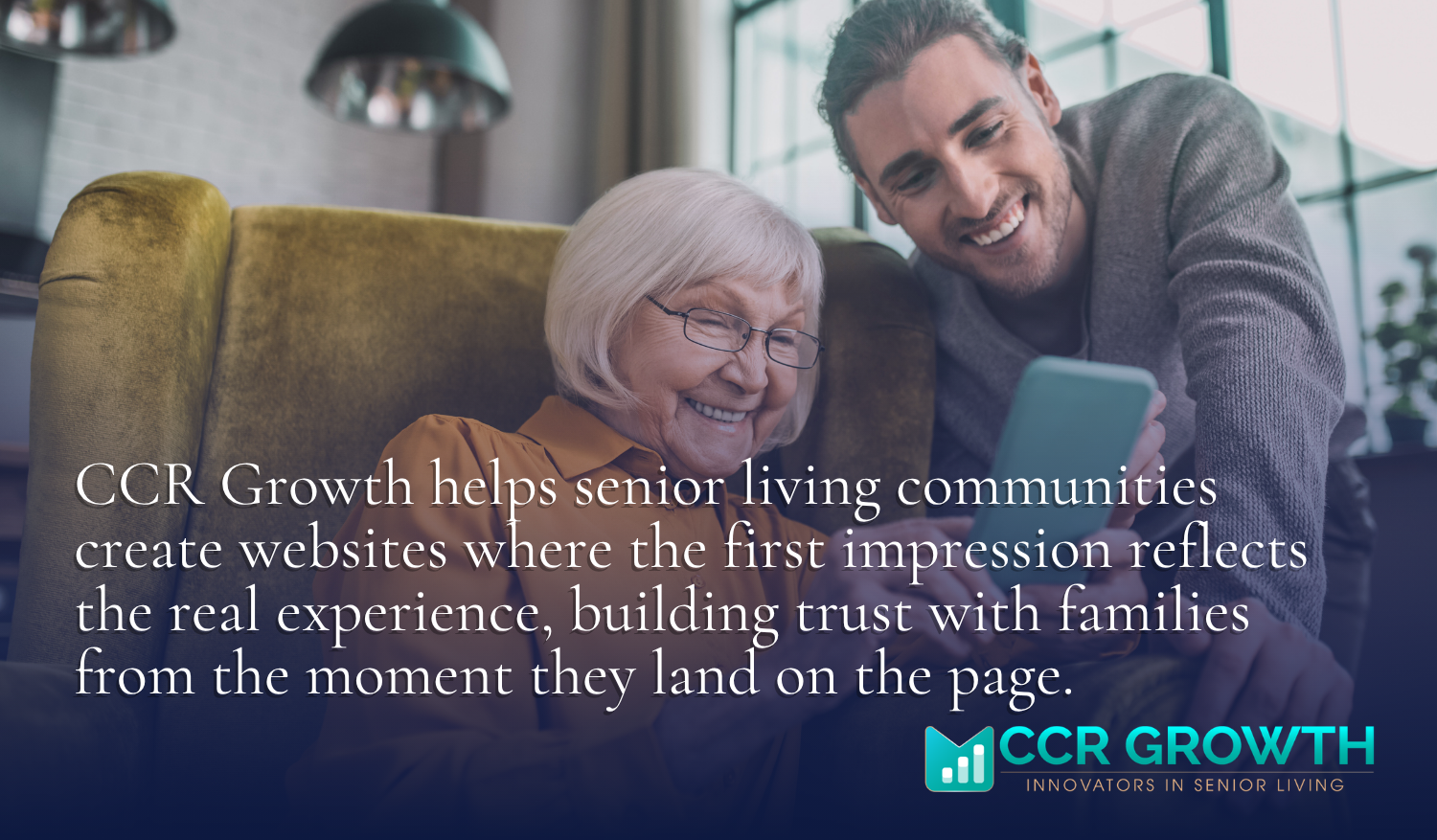
Your website is often the first interaction families have with your community.
That first impression carries weight.
If the website feels overly polished but lacks substance, visitors may question authenticity. If it feels confusing or incomplete, they may assume the same about your operations.
A strong first impression is created when your website reflects the real experience of your community. Design elements, imagery, tone, and content should align with what residents and their families experience every day.
This consistency helps visitors feel confident because expectations are set clearly from the beginning.
At CCR Growth, we see this alignment as a critical part of an effective senior living marketing strategy. When your digital experience matches your in-person experience, trust becomes easier to establish.
Clear navigation is one of the most overlooked ways to build trust.
Visitors should never have to search for basic information. They should be able to find details about services, amenities, care levels, and contact options quickly.
When navigation is intuitive, users stay engaged. They explore more pages. They gain a deeper understanding of your community.
This also supports search engines. A well structured website improves visibility online and helps your content reach the right target audience.
For seniors and their families, clarity matters. When information is easy to find, the website becomes a supportive resource rather than a barrier.
The communities that build trust online are not the ones making the strongest claims.
They are the ones providing the clearest answers.
A senior living website should guide visitors through the decision making process by reducing uncertainty, reflecting real life, and supporting informed decisions. When your content focuses on residents, services, and daily experiences instead of promotional language, families feel confident moving forward.
At CCR Growth, we help senior living communities create digital experiences that build trust, improve performance, and drive inquiries. If your website is not converting as expected, it may not be a traffic issue. It may be a trust issue. Book a strategy call with CCR Growth to identify where your website can better support your growth.
Content should address both emotional and practical concerns. Seniors often focus on independence and lifestyle, while adult children focus on safety and quality care. A balanced approach ensures both audiences feel supported.
Search engines influence visibility and credibility. Websites that provide informative content, strong structure, and consistent updates are more likely to rank well and be perceived as reliable sources.
Responsive design ensures your website functions properly across all mobile devices and screen sizes. This improves usability for mobile users and creates a more consistent digital experience.
Service pages should clearly explain what is included, how care is delivered, and what families can expect. Detailed content helps visitors make informed decisions before contacting your community.
A website becomes a powerful tool when it supports the entire journey, from initial research to inquiry. It should educate, guide, and reassure visitors rather than simply promote services.
"*" indicates required fields
Introducing

Do you own a botique senior living community? We built a dedicated, performance-based platform just for you!

