


Choosing a senior living community is one of the biggest decisions a family will make. It involves practical considerations, emotional conversations, financial planning, and confidence that the chosen community can support a loved one through the next chapter of life.
Yet many senior living websites still focus primarily on amenities, photographs, and broad marketing statements while leaving families to contact the sales team for basic information. The result is unnecessary friction during the research process.
The strongest-performing websites answer the same questions sales teams hear every day. They educate prospective residents and family members before the first inquiry, reduce uncertainty, and help visitors reach an informed decision with greater confidence.
Your website should do far more than showcase your community. It should answer questions and help families take the next step before they ever speak with your sales team.

Published on
8/12/2026
Every sales counselor can predict the conversation.
Many families ask exactly the same questions regardless of location, pricing, or care level. They want to know the monthly rent, what services are included, whether additional services cost extra, what happens if care needs change, and how daily life works inside the community.
These are not simply objections. They represent information gaps.
When an assisted living facility leaves those questions unanswered online, visitors either postpone contacting the community or continue comparing different communities that appear more transparent.
Your website should not force visitors to search elsewhere for information that your sales team already explains several times every day.
Families rarely begin their research knowing the differences between independent living, assisted living, memory support, or other senior living options.
They also may not understand medication management, personalized care plans, emergency call systems, or how healthcare providers work alongside community staff.
Instead of assuming visitors understand these concepts, explain them in straightforward language.
Describe how health care services support residents throughout changing care transitions. Explain when outside healthcare providers become involved, how assessments are performed, and how personalized care plans evolve over time.
Clear explanations reduce uncertainty while helping families determine whether your community is the right fit before contacting your sales team.
Families are not simply evaluating apartments.
They are trying to picture daily life.
That means your website should explain daily routines from morning through evening. Describe restaurant style dining, dining times, chef prepared meals, daily programs, scheduled transportation, transportation services, community life, outdoor spaces, common areas, movie theaters, Wi Fi availability, and opportunities for social interaction.
Visitors should also understand how independent living residents spend their day compared with residents receiving additional support.
Showing how new residents become part of the same community helps families picture the transition more realistically while creating a true sense of belonging before they ever visit.
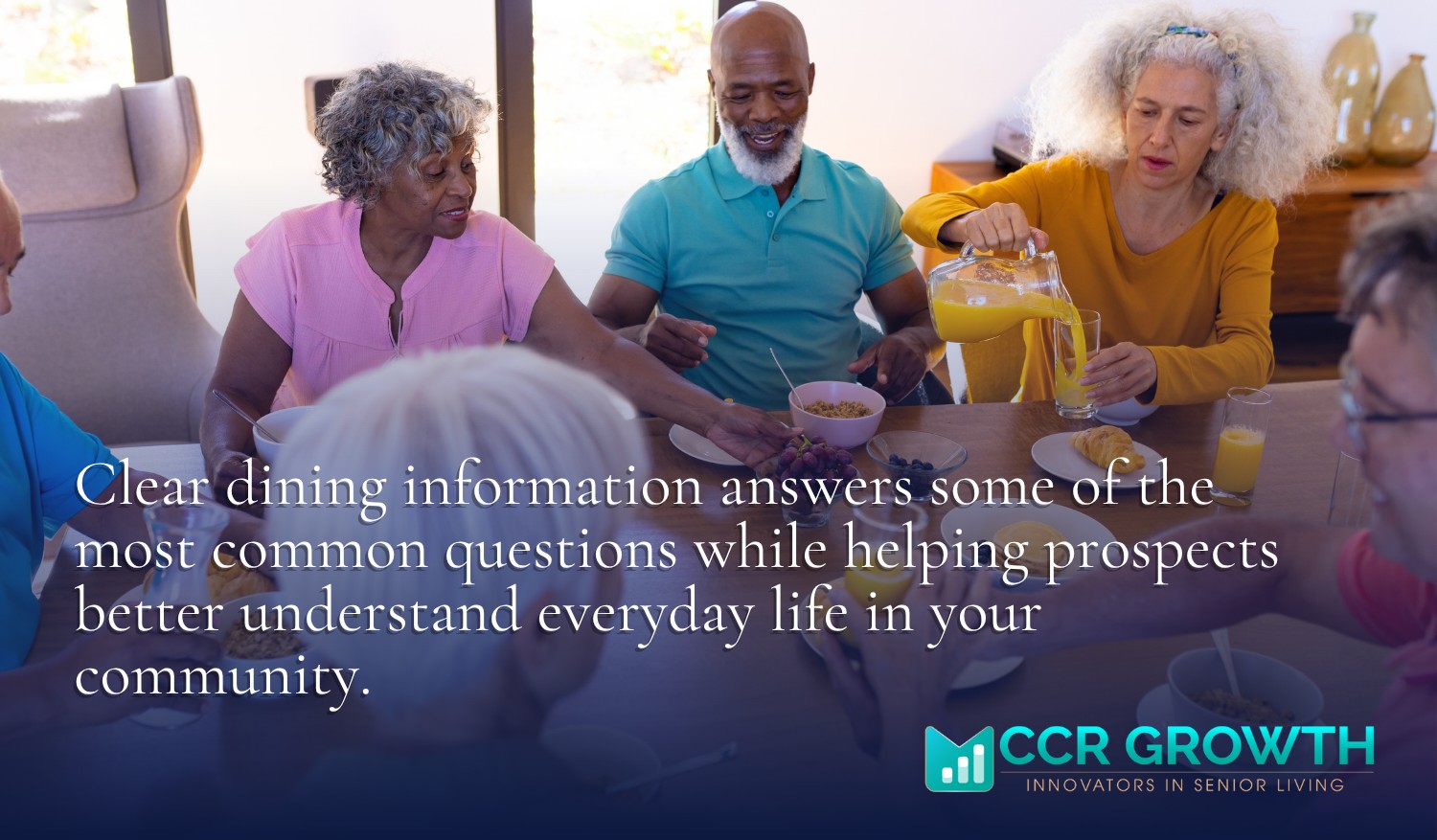
Food represents much more than nutrition.
Dining often becomes one of the strongest indicators of independence, routine, and emotional well-being.
Many families want answers to practical questions such as:
These conversations happen every day during tours, yet many websites barely mention them.
Helping visitors understand dining expectations creates a more complete picture of resident well-being and daily living while removing uncertainty before the first visit.
Safety remains one of the most important evaluation criteria for families.
Rather than making broad statements about resident safety, explain your emergency protocols, emergency call systems, staff to resident ratio where appropriate, staffing levels, background checks, staff training, medication management procedures, and how staff members respond during emergencies.
If your community has an executive director actively involved in operations, explain that leadership approach as well.
Families are not looking for marketing language.
They want valuable insight into how the community protects residents every day.
Pricing uncertainty often delays decisions.
Families understand that every community structures pricing differently, but they still expect a reasonable level of financial transparency.
Explain what the monthly rate includes, what services cost extra, which additional services may be added later, and how pricing changes when care needs increase.
The comparison below illustrates the difference between traditional website messaging and information that supports better purchasing decisions.
Traditional Website | Conversion-Focused Website |
Lists apartment sizes | Explains monthly rent and services included |
Mentions amenities | Explains daily life and community life |
General care descriptions | Details medication management and personalized care plans |
Generic dining information | Explains dining options, dining times, chef prepared meals, and dietary accommodations |
States transportation available | Explains scheduled transportation and transportation services |
Basic safety statement | Explains emergency protocols and emergency call systems |
Encourages tours | Helps visitors reach an informed decision before scheduling one |
Greater transparency allows many families to narrow their choices earlier, resulting in higher-quality inquiries and more productive tours.
The website should function as an extension of the sales process.
Every recurring sales conversation provides content ideas.
Every objection identifies information that is currently missing.
Every frequently asked question becomes another opportunity to improve website performance.
At CCR Growth, this approach sits at the center of senior living marketing optimization. Marketing should not generate more inquiries simply for the sake of higher lead volume. It should generate better-informed prospects who already understand your services, lifestyle, and expectations before speaking with your team.
When marketing and sales continuously share information, communities communicate more consistently across every stage of the buyer journey.
That consistency improves conversion rates while reducing time spent answering repetitive questions that could have been addressed online.
The conversations your sales team has every day contain some of the most valuable website content your community will ever create.
If families repeatedly ask about services, staffing, safety, dining, care transitions, costs, or resident life, those answers belong on your website.
The best communities recognize that websites should educate as much as they promote. When visitors arrive with realistic expectations and a better understanding of how you support residents, every inquiry becomes more meaningful and every tour becomes more productive.
If your website is not answering the questions your sales team hears every day, CCR Growth can help you build a content strategy that improves trust, strengthens conversions, and supports sustainable occupancy growth.
Yes. Explaining the role of the resident council demonstrates how residents participate in community decisions, provide feedback, and help shape community culture. It also reassures families that resident voices remain important after move-in.
Absolutely. Many visitors begin their search without understanding the differences between independent living, assisted living, memory support, and other senior living options. Educational content reduces confusion before the first inquiry.
Yes. Families appreciate knowing what furnishings, storage, accessibility features, and apartment layouts are included in each living space. This helps them compare communities more effectively.
In many cases, yes. Answering practical questions online allows sales teams to spend more time discussing individual needs rather than repeating basic information about services, pricing, or amenities.
Families are evaluating whether a loved one will enjoy their retirement years, maintain social opportunities, and receive ongoing support. Showing how senior living communities offer meaningful experiences helps visitors understand the lifestyle they can realistically expect rather than simply listing features.
"*" indicates required fields
Introducing

Do you own a botique senior living community? We built a dedicated, performance-based platform just for you!

