Mastering what genuinely moves families from inquiry to move-in, rather than following fleeting trends, is what the points below hone in on. The 2026 Playbook isn’t complex; it’s a strategic framework built on trust, speed, clarity, culture, and partnerships. By implementing these core pillars, senior living communities can transform unpredictable occupancy into a consistent, measurable outcome.
1. Families Buy Trust Before Features
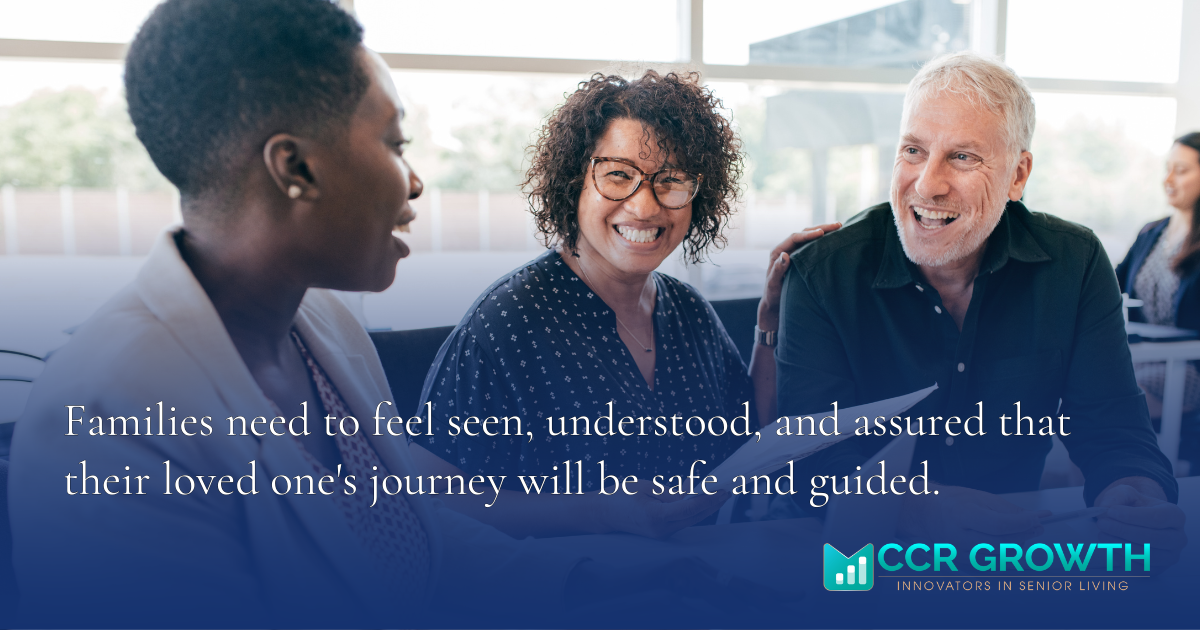
In senior living, the decision is deeply emotional, driven by fear, hope, and urgency. As we’ve discovered through countless conversations with our clients and guests on From Leads to Leases, families don’t primarily buy floor plans or activity calendars; they buy trust. They need to feel seen, understood, and assured that their loved one’s journey will be safe and guided. When this trust is established early, sales cycles shorten, and move-outs decrease.
A 2024 study by BMC Nursing confirms that “collaborative and reciprocal relationships” and communication that supports rather than merely informs are key enablers of participation and trust in long-term care decisions. Emotions are the driver of our major life decisions. So, how you make families feel matters more than mere bullet points about amenities.
The Playbook Move: Standardize Your Trust Pack
This is your baseline for transparent, confidence-building communication. It includes:
- Transparent Price Path: Clearly show “What you pay month 1”, “What you pay month 6”, and “What happens if care needs increase”.
- Simple Care-Level Explanation: Demystify care levels and associated fees upfront.
- Floorplan: Provide accessible visual information.
- Share a 2-minute Day-in-the-Life Video: Offer a glimpse into real community life, not just staged perfection.
- Create a “What to expect in your first 30 days” Guide: Proactively address transition anxieties.
Focus on being human from the outset, showing proof (videos, testimonials) rather than promises, consulting (truly listen to what your prospects have to say!) instead of selling, and designing marketing that showcases your community in real life.
2. Human Connection Beats Speed-to-Lead
Lead response time often gets misinterpreted as merely speed. Our interviews revealed that it’s not just how fast you reply, but who you reply with, how human that reply feels, and what you do next. The fastest, most meaningful reply wins.
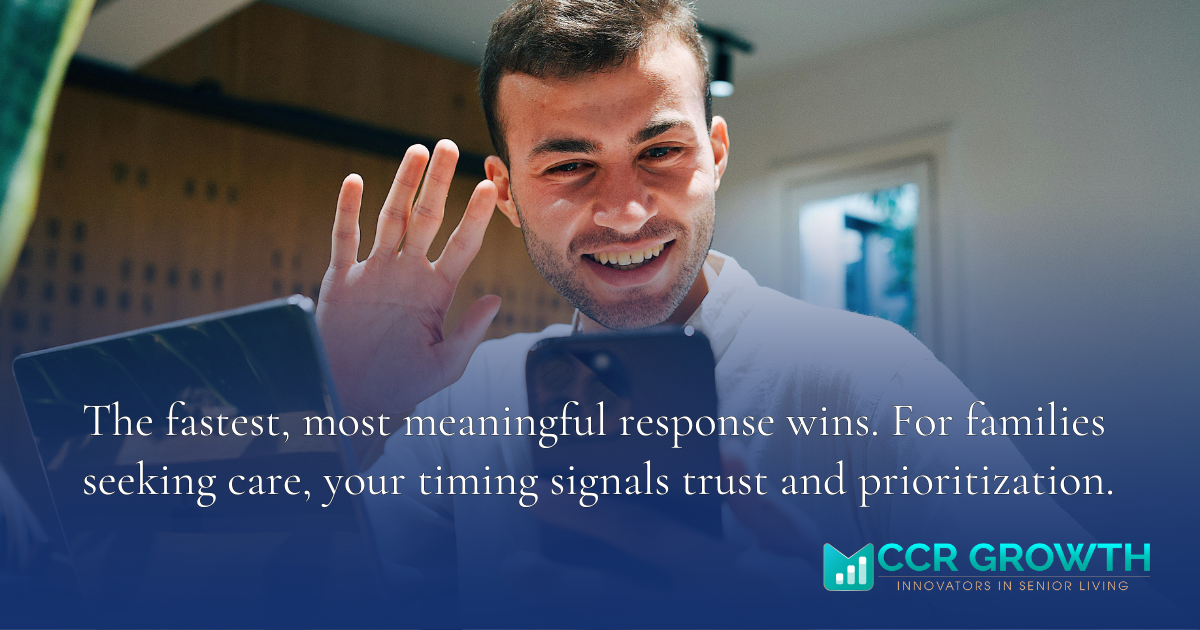
Research consistently shows the critical impact of rapid response. You’re 21 times more likely to qualify a lead if you respond within 5 minutes compared to 30 minutes, according to Harvard Business Review. Perhaps most strikingly, 78% of buyers choose the company that responds first. For families seeking care, timing signals trust and prioritization.
The Playbook Move: Win a Single Response Window
- Commit to a clear target, such as: A live person replies within 10 minutes, from 8 am to 8 pm.
- Measure actual human contact time, not just auto-responses.
- Train your team for the first 30 seconds of that call: acknowledge their journey before launching into features.
- Overcommunicate next steps immediately to build momentum.
- Audit your lead pipeline for any lag, identifying and rectifying bottlenecks.
3. AI That Gives Time Back to Caregivers and Sales
The biggest bottleneck in senior living isn’t always the building; it’s the administrative busy-work that eats up valuable hours. In the most successful communities, AI isn’t about a full digital transformation but about strategically reclaiming time.
With smart automations such as for data entry, note-taking and scheduling, we know that we can save hours each day. Findings from a 2025 study show efficiency gains of as much as 80 to 90% across various functions. Another report noted AI tools can reduce sales admin tasks by 40%.
On the care side, a LeadingAge case study showed a fall-detection AI system reduced caregiver response time from minutes to seconds. And, according to a survey by Argentum, 76% of senior care leaders believe AI will be “transformative,” and 50% already use it for marketing and sales efficiencies.
The Playbook Move: Automate the Right Tasks
Identify the two highest-volume, repetitive tasks for both sales and care teams (such as your CRM logging, follow-up emails for sales, daily incident documentation, status updates for care). Pick these two, and automate them.
- Select tools that reduce clicks and minutes, not just add another dashboard.
- Measure the time saved and reallocate it to human connection (more family calls, resident interaction).
- Ensure automation amplifies connection, it doesn’t replace it.
- Train your team to trust the AI system, involving them in its design and feedback.
4. Tour Quality Over Tour Count
High tour numbers mean little if they don’t convert. The most successful communities prioritize immersive, emotional, and relevant tours that are anchored in the family’s decision-moment.
Senior Housing News reported one community achieved a 46% tour-to-move-in ratio by shifting to tailored “experiences,” significantly higher than the industry average of 23-25%. A 2024 BILD & Co study confirmed that high inquiry rates don’t guarantee occupancy growth if tour quality is low. A tour is more than walking a prospect through your buildings. It’s a chance to showcase how your community can feel like home to them.
The Playbook Move: Run a Monthly Tour Lab
Design a structure for continuous tour improvement:
- Pre-tour discovery: Understand values, fears, and preferences before the tour.
- Live action vs. showroom: Showcase residents engaged, staff visible, and real daily life.
- Emotionally-anchored stories: Use “day-in-the-life” narratives.
- Meet a resident or family: Authentic voices build trust faster.
- Close with the next step: Aim to set a move-in conversation or follow-up during the tour.
- Measure tour quality: Track tour-to-move-in rate and meaningful interactions, not just quantity.
5. Pricing Clarity, Not Deeper Discounts
Leaning on discounts creates a race to the bottom and can erode trust. Sustainable occupancy is driven by clear pricing that builds confidence and helps families perceive value.
As cost pressures stabilize, senior living operators are finding success in more transparent pricing structures at a community level. “The “great unbundling” of care fees in 2024 set the foundation for a more structured and transparent model in 2025,” according to an article in McKnights Senior Living. Pricing transparency and service clarity is a critical part of helping to drive decisions sooner.

The Playbook Move: Publish Your Rate Logic
- Lead with a “clear price path” on your website and in initial sales discussions.
- Avoid a reactive “discount mindset” unless strategically tied to clear value.
- Communicate care-level rates openly to prevent misunderstandings.
- Frame pricing in a decision-making context, comparing the investment to the value received.
- Ensure your entire team can articulate the price path and its value.
- Measure internal lag times around pricing discussions to identify friction points.
6. Staff Stability Comes from Micro-Training and Small Wins
You cannot build a stable, high-performing team on annual training alone. Consistent, small training moments and the celebration of minor successes build confidence, reduce turnover, and improve resident experience.
A report from AHCA/NCAL shows that the rate of staff turnover in senior care is lower; good news for the industry since high staff turnover comes with high costs to both your bottom line and how your target audiences perceive your community’s brand. Training and development can positively influence job satisfaction for long-term care employees. High turnover also correlates with increased facility deficiency ratings.
The Playbook Move: Teach One Skill Per Shift for Two Week
- Pick one specific behavior per shift (e.g., “verbally announcing name and next step within 30 seconds of a fall alert”).
- Build a micro-training library of 5-10 minute videos or role-plays.
- Celebrate small wins publicly and immediately to reinforce behavior.
- Link training to outcomes families care about (e.g., “We’re training this because families first felt-moments determine trust”).
- Track and measure these micro-wins to build momentum and confidence.
7. Partnerships That Shorten the Care Journey
Effective partnerships aren’t just about having a vendor list; they’re about integrated, transparent alignment that confidently answers the crucial question: “What happens next if needs change?” This assurance reduces fear and accelerates trust.
One study emphasizes that partnerships between senior care and healthcare providers are vital as older adults expect a continuum of care. It also shows that partnering with complementary service providers achieved better care outcomes.
Research shows older adults in housing sites connected with wellness programs and care providers had lower hospitalization rates and readmissions. The NORC/NIC study further found that older adults in senior housing with integrated care pathways received more preventive care and had lower inpatient admission rates for various conditions. Strategic alliances enhance service offerings while reducing costs and improving experience.
The Playbook Move: Document Three Partner Handoffs
- Map the next 90-day path before move-in: Show a simple diagram of what happens (e.g., move-in → home-health partner visit → therapy assessment → long-term plan).
- Formalize partnerships: Choose 2-3 core partners (home health, therapy, hospice) with clear roles and communication protocols.
- Include partner introduction in tours: Proactively introduce partners as part of the community’s integrated support system.
- Measure outcomes: Track “time from inquiry to move-in” and “regretted move-outs due to increasing care needs” to assess partnership impact.
- Differentiate your story: Highlight these partnerships in your marketing as a key value proposition.
8. A Unified System for Predictable Growth
No single strategy alone drives growth in senior living. Predictable occupancy emerges when multiple small systems work in concert consistently, predictably, and in alignment. The real enemy of occupancy isn’t the market; it’s friction across the entire customer journey.
The Playbook Move: Integrate Everything
- Families buy trust: Built fastest by human response, clarity, and emotional tour experiences.
- AI gives time back: Freeing teams to deliver those high-quality, human-centric experiences.
- Partnerships reduce fear: Providing assurance about future care.
- Staff stability ensures consistent delivery: Because a happy, trained team translates directly to a better family experience.
When trust, speed, clarity, culture, and follow-through work together, occupancy becomes predictable, revenue stable, teams confident, and families reassured.
Final Thoughts: The 2026 Playbook Only Works If You Do
Growth isn’t about doing more; it’s about focusing on the right things and executing them consistently and with intention. This means committing to: winning one response window, designing one tour improvement each month, anchoring your team with one micro-training behavior, defining one pricing path, establishing one set of core partnerships, and teaching one skill per shift.
These commitments require leadership, accountability, and a willingness to simplify relentlessly. By integrating these eight strategies, 2026 won’t be chaotic or unpredictable. It will be the year your growth is intentional, predictable, and fully under your control.
If you’re ready to truly operationalize trust, speed, and clarity into your daily systems CCR Growth is your partner in making this Playbook a reality. We specialize in transforming these insights into income, turning friction into flow, and building measurable systems that grow occupancy predictably.
Don’t just plan for a better year; make it happen. Connect with us to discuss how we can help you implement your 2026 Playbook and achieve the predictable growth your community deserves.