



CCR Growth
Best Generative AI Chatbots by Market Share in 2026
Generative AI chatbots have transitioned from early innovation to mainstream business infrastructure. In 2026, these AI tools are essential to how organizations, including senior living communities, handle customer self service, marketing inquiries, and customer conversations.
Understanding which generative ai powered chatbots dominate by market share helps senior care leaders make informed, future-ready technology decisions. When you choose an AI powered chatbot, its platform maturity, data handling, and conversational accuracy directly affect how your contact center performs and how residents and families experience your community.
This post examines the best generative AI chatbots by market share in 2026, what they do, why they matter, and how they’re reshaping customer support and customer experience across industries.

Outline



Published on
12/10/2025
Key Takeaways
- In 2026, Generative AI chatbots are central to customer self service and digital engagement in senior living.
- Market leaders like ChatGPT, Copilot, and Gemini set new standards for conversational AI performance and accuracy.
- Implementing AI powered chatbots helps communities respond faster, reduce costs, and enhance customer experience.
- Senior living operators leveraging AI technology gain stronger communication, lead conversion, and resident satisfaction.
What Are Generative AI Chatbots
A generative AI chatbot is an advanced computer program built on large language models (LLMs) that simulate human language conversations. Unlike a traditional chatbot that depends on pre-programmed responses, these systems draw on advanced artificial intelligence and natural language processing to interpret intent, sustain conversation flow, and deliver accurate, context-aware answers.
Each chatbot is powered by an underlying AI model trained on vast amounts of data. Through natural language processing, they interpret a user’s query, predict the most relevant answers, and generate natural responses on the fly.
Modern conversational AI systems, such as virtual assistants and virtual agents, can perform specific tasks, automate tasks, handle repetitive queries, and offer support through voice assistants, mobile apps, and messaging platforms.
In senior living operations, this means an AI agent can handle inquiries like, “Do you offer memory care?” or “Can I schedule a tour?” with immediate, personalized answers, while seamlessly escalating complex issues to human agents.
What Generative AI Chatbots Do
Generative AI chatbots bring together AI technology, natural language processing, and automation to enhance the entire customer interaction lifecycle.
They can:
- Answer questions in conversational language, eliminating the need for rigid FAQ navigation.
- Support customer self service, enabling prospects and families to get help instantly.
- Power conversational interfaces across websites, mobile apps, and messaging platforms.
- Use sentiment analysis to read tone and emotion, adjusting replies to delight customers.
- Apply intelligent routing to pass complex or emotional matters to human agents.
- Use training data to continuously optimize dialogue accuracy and relevance.
- Integrate with business systems to capture leads, send reminders, or complete complex tasks automatically.
In a senior living context, these AI powered chatbots serve as reliable virtual assistants, responding to inquiries 24/7 while maintaining the empathy and tone your brand requires.
Why Senior Living Communities Need Generative AI Chatbots
For senior living operators, the demand for customer support is constant. Families expect quick, consistent, and compassionate responses — even after hours. Here’s why forward-thinking communities are integrating generative ai chatbots into their contact center and marketing systems:
Scalability without added staff
A single chatbot can manage thousands of customer conversations simultaneously, across mobile apps, websites, and messaging platforms, freeing your team from handling routine interactions.
Improved customer experience
Through advanced natural language processing, these AI agents can engage in fluid, human-like dialogue. They recognize tone, intent, and context — key to making each conversation feel authentic.
Enhanced self service
Generative AI reduces dependence on human agents for basic queries, offering instant, accurate help that shortens wait times and raises satisfaction.
Consistent, brand-safe messaging
Each response aligns with your tone and values, something critical in senior care communication.
Data-driven insights
Every customer interaction provides actionable data that can reveal what families are asking most often, what barriers to conversion exist, and how to improve marketing and operations.
Seamless escalation for complex issues
When a situation requires human understanding, the chatbot performs intelligent routing, transferring context and sentiment to a human agent who can resolve it.
Pros and Cons of Generative AI Chatbots
Like any evolving AI technology, generative AI chatbots come with distinct advantages and challenges. Understanding these strengths and limitations helps communities implement AI powered chatbots effectively while maintaining a consistent and reliable customer experience.
Pros
- Human-like conversation through natural language comprehension and contextual learning
- Ability to handle vast amounts of data and generate new content dynamically
- Reduced operational cost through customer self service
- Continuous improvement via training data and feedback loops
- Integration across messaging platforms, voice assistants, and web channels
- Ability to automate tasks and manage specific tasks consistently
Cons
- Risk of inaccurate or “hallucinated” answers if not properly supervised
- Requires rigorous data management to protect sensitive resident information
- Infrastructure and compute costs can grow with large language models
- Must balance automation with the empathy that humans bring to customer support
Generative AI Chatbots by Market Share (2026 Projection)
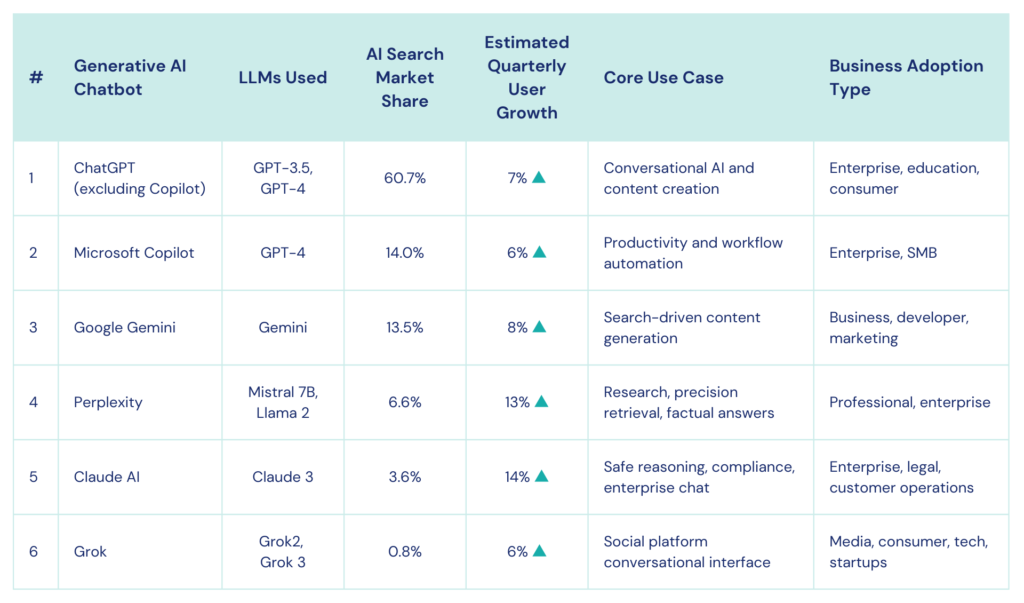
The figures below demonstrate how ChatGPT continues to dominate generative AI, commanding over 60 % of global AI chatbot activity, followed by Microsoft Copilot and Google Gemini.
Notably, Perplexity and Claude AI show the fastest growth rates, driven by improvements in retrieval accuracy, safety, and reasoning capabilities.
The Best Generative AI Chatbots by Market Share in 2026
The generative AI chatbot market has rapidly evolved, and in 2026, a few key players will now define how conversational AI and AI powered chatbots support communication.
1. ChatGPT (OpenAI)
The market leader. ChatGPT’s dominance stems from its mature AI model, broad plugin ecosystem, and adaptive conversation flows. Its large language models handle context, sentiment, and nuance at scale, making it the most capable choice for customer experience automation.
2. Microsoft Copilot
Built on GPT-4, Copilot integrates seamlessly into Microsoft 365, Teams, and Dynamics. For organizations already embedded in Microsoft ecosystems, it’s the most natural choice to automate tasks, create content, and improve contact center productivity.
3. Google Gemini
Gemini’s advantage lies in its connection to Google Search and Workspace. It excels at content creation, knowledge retrieval, and reasoning across vast amounts of data, ideal for marketing or documentation-heavy environments.
4. Perplexity
Positioned as a precision-oriented AI search engine, Perplexity combines gen AI generation with retrieval-based answers. Its AI powered chatbot is gaining attention for transparency, citations, and factual reliability — valuable traits when addressing resident or family customer queries.
5. Claude AI (Anthropic)
Claude focuses on ethical AI and controllable reasoning. Designed for businesses, it’s increasingly chosen for complex issues and enterprise-grade compliance needs, where safe conversation flows matter more than mass adoption.
6. Grok (X AI)
Though currently small in share, Grok’s rapid iteration cycle (Grok 2 → Grok 3) and integration with X’s social platform give it unique real-time communication potential. Its conversational humor and contextual understanding showcase how chatbots work in live data environments.
How Generative AI Chatbots Impact Customer Experience
The rise of AI powered chatbots directly transforms how business teams manage customer support and communication. These systems can interpret tone through sentiment analysis, personalize each conversation, and maintain context — all at scale.
In senior living, this means prospective residents and their families no longer wait for office hours to get answers. A well-designed chatbot can guide them through pricing inquiries, care options, or scheduling tours instantly, while still escalating emotional or nuanced matters to human agents.
Generative AI chatbots enhance overall customer experience by creating frictionless customer interactions, blending automation and empathy. As AI technology advances, the boundary between machine and human language comprehension continues to blur, offering unprecedented opportunity to delight potential residents and improve customer experiences.
Final Thoughts
In 2026, generative AI chatbots will be the backbone of customer self service and conversational AI systems. With ChatGPT leading the field and rapid innovation from Microsoft Copilot, Google Gemini, Perplexity, Claude, and Grok, the race to dominate customer experience and ai powered support is accelerating.
For senior living communities, these technologies aren’t abstract. They represent practical tools to automate engagement, capture leads, and extend care through digital conversation. The winners will be those who strategically deploy AI powered chatbots that respect privacy, maintain empathy, and leverage data to continually improve the chatbot experience.
As artificial intelligence evolves, aligning it with your organization’s human-first mission ensures you deliver what matters most: responsive, compassionate communication that strengthens trust and connection.
Ready to explore how generative AI chatbots can enhance engagement and lead generation for your community? Partner with CCR Growth to implement intelligent, human-centered AI solutions that elevate every customer interaction.
Frequently Asked Questions
1. How does an AI Agent work within a contact center?
An AI agent functions as an extension of your contact center, managing initial conversations, identifying intent, and applying intelligent routing to escalate when needed. It learns from training data and integrates with existing CRMs to manage high volumes of customer support tasks without fatigue.
2. How does conversational AI differ from traditional chatbots?
Conversational AI uses large language models and machine learning to understand human language, while traditional bots rely on pre programmed responses. This means conversational systems can interpret context, manage follow-up questions, and generate new content — enabling smooth, continuous dialogue.
3. How do AI powered chatbots handle vast amounts of data?
AI powered chatbots rely on deep learning algorithms that analyze vast amounts of data during training. This helps them understand intent, infer context, and generate accurate answers. When combined with sentiment analysis, they can detect tone and emotion, tailoring responses to each user’s query and enhancing the chatbot experience.
Subscribe to our newsletter
Sharpen your expertise and stay ahead of senior living industry trends—subscribe to CCR Growth’s newsletter for exclusive insights and updates.
Recent Posts


Hello & Welcome!
We'reRedefining Senior Living Marketing, Sales, and Operations
Delivering a customized approach generating $1.5M and up in additional revenue for every community
CONTACT ADDRESS
8710 Carmel Valley Road, Carmel, CA 93923
GENERAL INQUIRIES
info@ccrgrowth.com
833-448-3459
SOCIAL MEDIA